
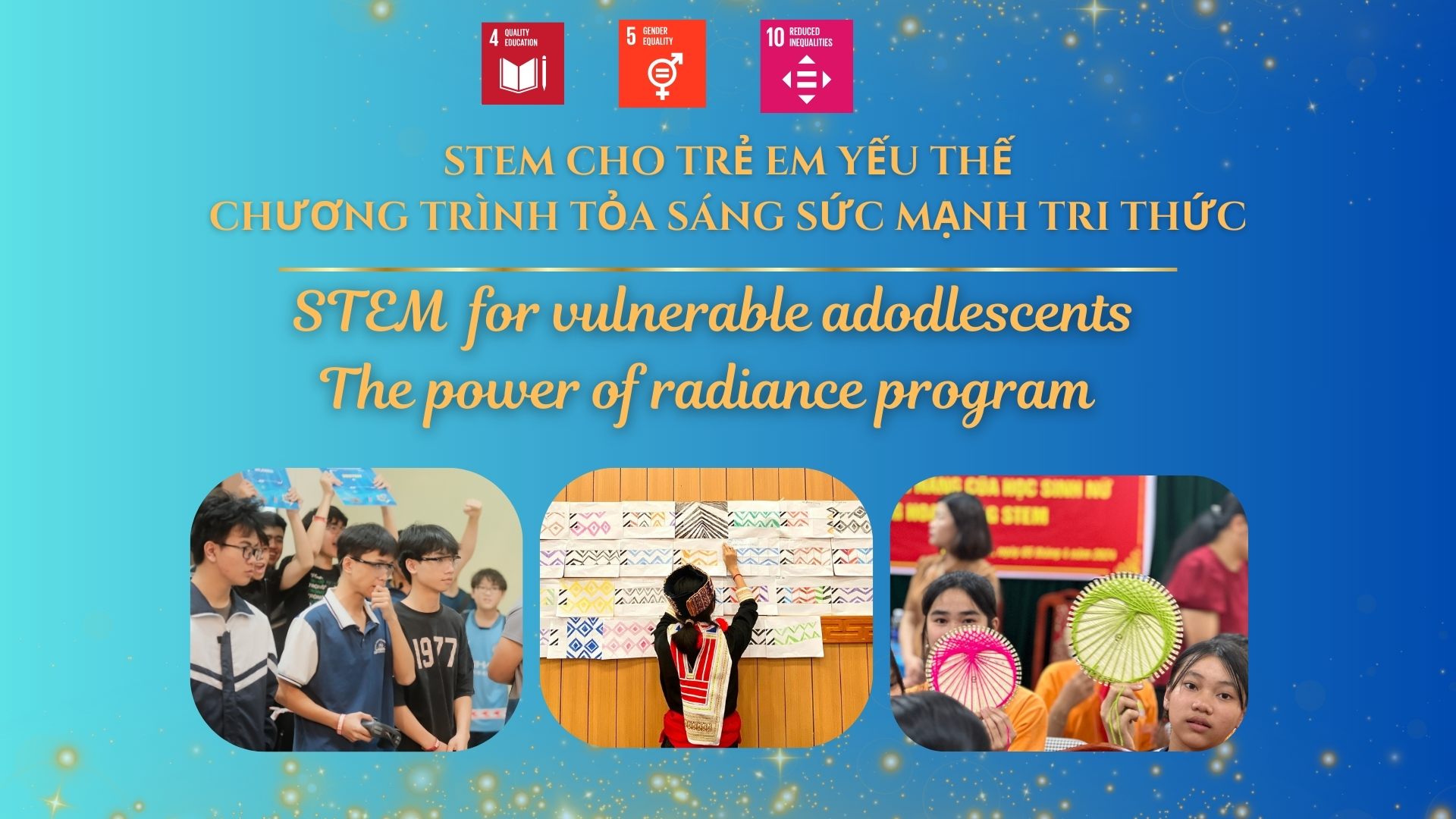
The Power of Radiance
STEM for Vulnerable Adolescents
Nurturing scientific curiosity, confidence, and access to quality STEM learning for the students who need opportunities the most.
Inspired by the 2023 Power of Radiance Award, this SEPA initiative has grown into a long-term journey to bring quality STEM education to girls, rural and mountainous students, ethnic minority students, and students with disabilities.
Project origin
Empowering students through knowledge, starting from communities with fewer opportunities
The project originated from the 2023 Power of Radiance Award, for which UNICEF nominated Dao Thi Hong Quyen in Viet Nam. The award, presented by Clé de Peau Beauté, recognized her contributions to advancing STEM education for girls through sustainable and creative educational activities.
Building on this foundation, the project expands its impact to students in mountainous areas, girls, students with disabilities, and communities facing barriers to quality education. Its goal is not only to bring STEM to students, but also to help them recognize their own capabilities.
Overview
Reducing educational gaps through STEM that is accessible, creative, and locally relevant
STEM for Vulnerable Adolescents focuses on teacher training, locally relevant STEM activities, the use of emerging technologies in education, and inclusive learning environments. Lessons are not limited to textbooks; they also come from nature, local culture, traditional crafts, community challenges, and real-world data.
Key achievements
Milestones showing that STEM can reach every student
51 training sessions across 13 provinces
More than 12,000 teachers and 2,084 educational managers were connected, trained, and supported to implement STEM education.
Promoting STEM for girls
The project supported girls’ robotics clubs and STEM workshops, encouraging girls to confidently enter science, technology, and innovation fields.
UNESCO recognition
Gia Thanh Secondary School received recognition for an innovative teaching approach that integrated the living heritage of the Vietnamese conical hat into mathematics and science.
Physical and virtual robotics
Virtual robots, educational robots, and technology tools were used to increase access, including support for teachers working with deaf and hard-of-hearing students.
Inclusive Technology Pioneer Award 2024
The project was recognized at the 2024 Multistakeholder Forum for its efforts to promote inclusive technology and education for vulnerable groups.
Local ecosystem building
The project contributes to local STEM ecosystems by engaging teachers, schools, educational managers, parents, and partner organizations.
Three core components
An inclusive STEM model connected with nature, culture, and people
STEM for rural and mountainous communities
Bringing STEM education to rural, mountainous, and underserved areas through teacher training, STEM days, clubs, and hands-on activities using accessible local materials.
Learn moreSTEM for girls
Encouraging girls to participate in science, technology, robotics, and innovation while challenging gender stereotypes in learning and career choices.
Learn moreSTEM for students with disabilities
Creating equitable access to STEM education for students with disabilities through adapted learning materials, assistive technologies, and inclusive teaching methods.
Learn moreSustainable development
Contributing to the Sustainable Development Goals
The project contributes to SDG 4 on quality education, SDG 5 on gender equality, and SDG 10 on reduced inequalities. Its approach does not only bring STEM into classrooms, but also connects STEM with local culture, nature, community life, and sustainable development needs.
Vision toward 2025
The project continues to expand to communes, wards, and local communities, with a strong focus on STEM education connected to culture, nature, and real-life challenges. SEPA seeks to work with teachers, schools, local authorities, and partner organizations to build an inclusive STEM education ecosystem where every student has the opportunity to discover their potential.
Connect with SEPA