
Summer is when teachers can take time to learn before the new school year. Between June and the end of August 2023, the STEM for Vulnerable Adolescents project ran 11 training rounds in six provinces and cities, with 2,540 teacher and manager participations.
Summer training schedule
| Date | Location | Managers | Teachers |
|---|---|---|---|
| 11–14 Jun | Me Linh district, Hanoi | 70 | 200 |
| 25 Jul | Chi Lang district, Lang Son | 40 | 100 |
| 26 Jul | Van Lang district, Lang Son | 40 | 100 |
| 27 Jul | Cao Loc district and Lang Son city | 30 | 120 |
| 28 Jul | Lang Son province – science & engineering research module | – | 120 |
| 4 Aug | Lang Chanh district, Thanh Hoa | 40 | 200 |
| 11–12 Aug | Thai Thuy district, Thai Binh | 280 | 300 |
| 12–13 Aug | Dong Hung district, Thai Binh | 150 | 200 |
| 17 Aug | Thanh Chuong district, Nghe An | 40 | 160 |
| 23–24 Aug | Viet Tri city, Phu Tho | 50 | 120 |
| 26 Aug | Phu Tho town, Phu Tho | 70 | 110 |
Three forms of STEM education in schools
The training follows the Ministry of Education and Training’s guidance on three forms of STEM education: teaching science, maths, technology and computing subjects through a STEM approach; running STEM experiential activities and clubs; and guiding students in science and engineering research. Each district received its own programme, based on a pre-training survey.
- Scientific inquiry: STEM lessons in the natural science subject, working back from curriculum outcomes to a lesson outline.
- Engineering design: moving from “recycled-materials STEM” to lessons that build design thinking, with 2D drawings and product criteria.
- Science and engineering research: variables, methods, predictions, posters and research reports.
- Robotics and AI: the role of robots in schools, virtual robot programming, and AI tools for teachers.
Learning by doing
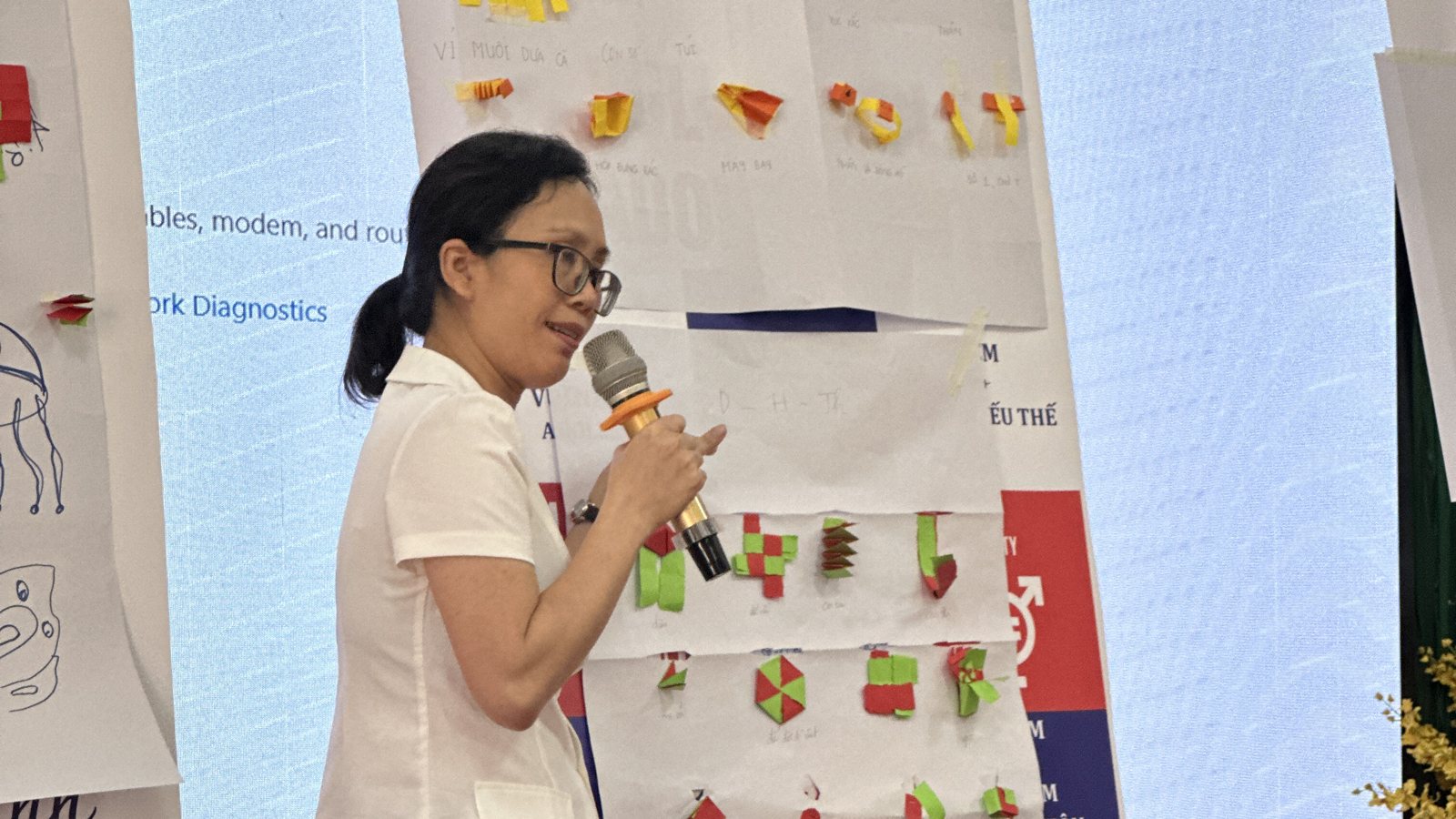
In Van Lang, groups of teachers wove coloured paper into structures and then pitched their designs to the room. The simple task lets teachers live through what their students will: define the problem, sketch, build, test and improve.
Thai Thuy and Dong Hung (Thai Binh) had the largest turnout, with 930 managers and teachers between them. Together with Thanh Chuong (Nghe An), these districts have strong school reading cultures, a factor the trainers have found helps STEM education take root faster.
Learning continues after the training
So that learning does not stop when the workshop ends, the project and the National STEM Festival organisers planned a series of short online sessions (microtraining) for the 2023–2024 school year. Volunteer experts cover building a school STEM programme, engineering design, design thinking and 2D drawing, scientific inquiry, research methods, maths in STEM, virtual robot programming and STEM in primary schools. Teachers who complete the training can register for a project certificate.