
NASA Space Apps Challenge Hanoi 2026 kicks off in just a few days. In 48 hours, every team must turn a NASA challenge into a working product and win over the judges. What should teams focus on in the final days, and which mistakes cause good ideas to miss out on awards? SEPA spoke with members of the judging panel and the parent of the team that won First Prize in 2025.
1. Dr. Mai Xuan Trang: Commit to one challenge and show a working demo
What should teams focus on in the final days before the event?
- Pick one challenge and stick to it. Space Apps offers many challenges (environment, climate, space data…). The most important first step is to choose the one challenge that fits your team’s skills and commit to it, instead of changing direction halfway through a 48-hour event.
- Read the challenge “Resources” carefully. Every challenge points to data from NASA and its partners (Earth data, open APIs…). Check in advance that the data can actually be downloaded and used, so you don’t spend half the event debugging data access.
- Assign clear roles. Who handles data and engineering, who handles design and user experience, who presents. Judges assess not only the code but also how the team tells its story.
- Sketch a minimum viable product (MVP) beforehand. Outline the architecture and interface (storyboards, wireframes) in advance, so that during the event you only need to build it, rather than losing the first hours wondering what to do.
- Rehearse your presentation. Judging time is short, usually just 5–7 minutes per team. Practise your demo and slides early; don’t leave them to the last minute.
Which common mistakes keep a good idea from scoring well?
- No working demo. Judges need to see the product working, even as an MVP, not just hear an idea backed by beautiful slides.
- Using NASA data only for show. Challenges usually call for a specific open dataset, yet many teams add the NASA logo without actually using the data to solve the problem. This costs heavily under the competition’s Validity/Relevance criterion.
- Weak Feasibility & Impact. An ambitious idea that cannot explain who will use it, how, and which real problem it solves. Judges often ask directly: “Who is the end user, and how do they benefit?”
- An unfocused pitch. Spending too much time explaining the technology instead of following the order judges want to hear: problem → solution → impact.
2. Judge Le Bao Anh: Make the most of youthful creativity
What should teams pay attention to right now?
Teams should think carefully about how they will carry out the project: the product should match the team’s abilities and show real product-design thinking.
What strengths should young and first-time participants play to when competing against more experienced teams?
Young participants and first-time teams have creativity, enthusiasm and less pressure on their shoulders. Their ideas have not been polished into familiar patterns, so their products can be genuinely surprising. My advice is to make the most of your creativity, keep learning and give it everything you’ve got.
Le Bao AnhJudge, NASA Space Apps Hanoi 2026
3. Assoc. Prof. Le Chi Ngoc: 9 serious mistakes to avoid when building your product

At the NASA Space Apps Hanoi 2026 Kick-off at the U.S. Embassy, Assoc. Prof. Le Chi Ngoc highlighted the mistakes that cost a product points, even when the original idea is strong:
- Adding AI for its own sake: using AI without explaining the value it adds.
- No comparison with a simple baseline: failing to show the algorithm beats a simpler approach.
- Undisclosed synthetic data, which makes the evaluation untrustworthy.
- Impressive metrics built on a flawed experimental method.
- No uncertainty reported, creating a false sense of precision.
- No sources cited, so conclusions cannot be verified.
- Too many features and no complete core user flow.
- A demo that cannot be reproduced, with no proof the product works beyond a video.
- Off-scope work: the product may be good but does not address what the challenge asks.
4. Dr. Cao Thi Luyen: Lessons from the 2025 First Prize team
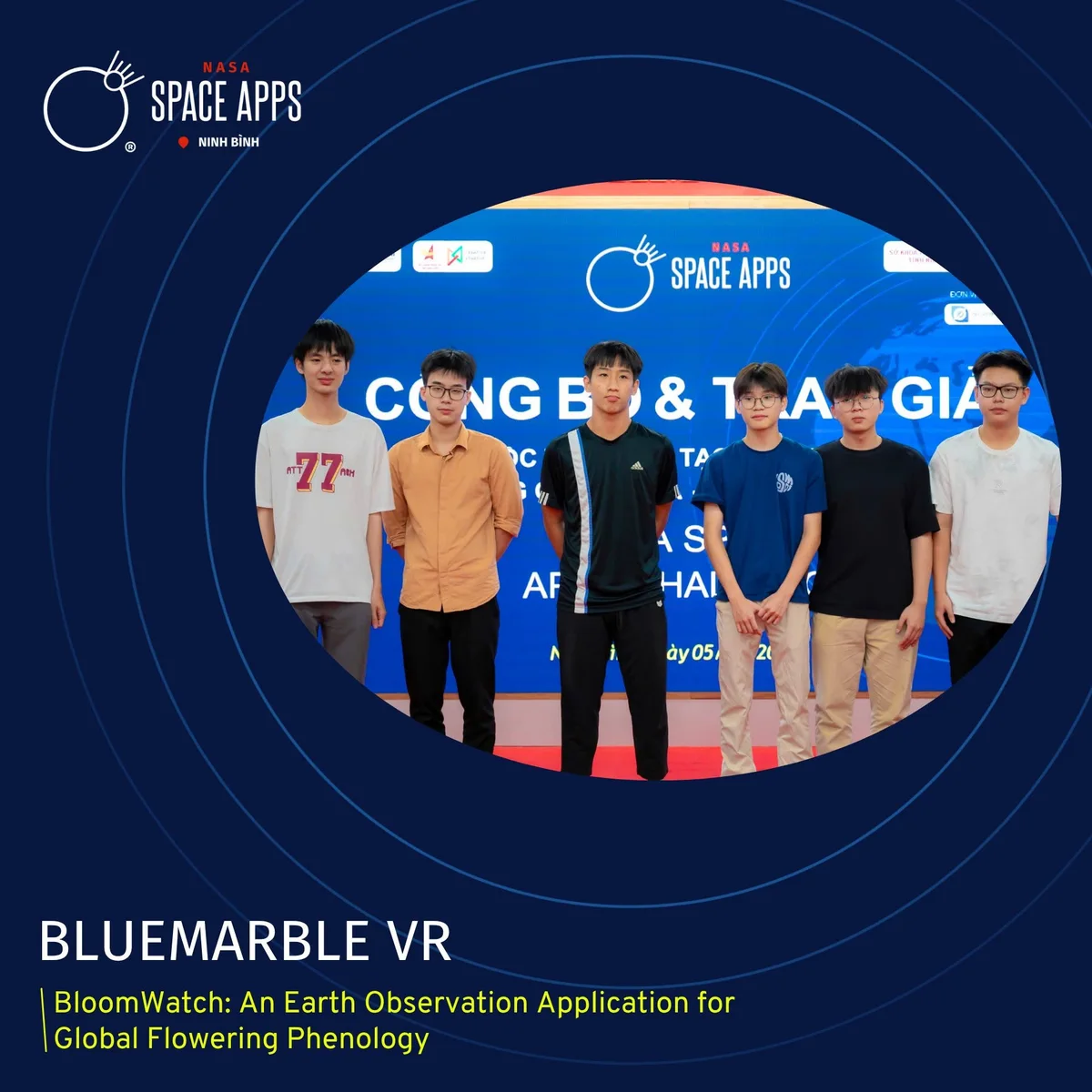
In 2025, team BlueMarble VR won First Prize and the Art & Technology Award, and was nominated for global judging. Having followed the team’s project closely, Dr. Cao Thi Luyen shares practical lessons, especially for first-time participants.
Define the right problem
A project should start from a real, meaningful problem, not from the goal of winning a prize. Teams need to be clear about who faces the problem, how serious its impact is, and why existing solutions fall short. This is the basis for choosing the solution, the data and the evaluation criteria.
Limit the scope of your product
With so little time, define the scope from the start. A prototype with few features that runs reliably, uses NASA data for the right purpose and can be demonstrated is better than a feature-rich system that is unfinished.
Use NASA data effectively
NASA data is vast and rich. Teams need to study it to extract the information that matters for their problem, and state clearly which datasets they used, where they came from, how they were pre-processed and what role the data plays in the results.
Divide work by strengths
One member can take on several roles, but every task needs one person who is primarily responsible. The team leader should be someone who can coordinate and see the big picture, not necessarily the best programmer. Every member should understand the product well enough to answer the judges’ questions.
Prepare your pitch and Q&A
The presentation should be logical and include a demo. Prepare answers to these 5 questions in advance:
- What problem does the project solve, and why did you choose it?
- Which NASA data did you use, and how did you process it?
- How is your product different from existing solutions?
- How far has the product been tested, with whom, and with what results?
- What are the next steps?
Present results honestly and at the level actually achieved. Label test results as tests, and back up user feedback with concrete evidence.
Always have a backup plan
Store and sync your data in at least two places, with backups in case something unexpected happens.
The competition is a chance to build research skills, teamwork and product development. Experience shows that a good project doesn’t need to start from a big idea. What matters is understanding the problem correctly, making the most of each member’s strengths, seeing it through and continuously improving the product.
Dr. Cao Thi LuyenParent, team BlueMarble VR, First Prize, NASA Space Apps Challenge Ninh Binh 2025
5 things to remember before kick-off
- Choose one challenge, see it through and stay within its scope.
- Test NASA data in advance and genuinely use it to solve the problem; cite your sources.
- Build a small MVP that actually works, with a reproducible demo, not just a video.
- Pitch in the order problem → solution → impact, and be honest about results.
- Assign clear roles, make sure everyone understands the product, and always keep a backup.
We wish every team at NASA Space Apps Challenge Hanoi 2026 an explosive 48 hours of creativity and truly impressive products!